Living in Canyelles and Olivella: prices, transport and services
Living in Canyelles or Olivella: home prices, residential developments and their charges, bus and train to Barcelona, schools and who it suits.
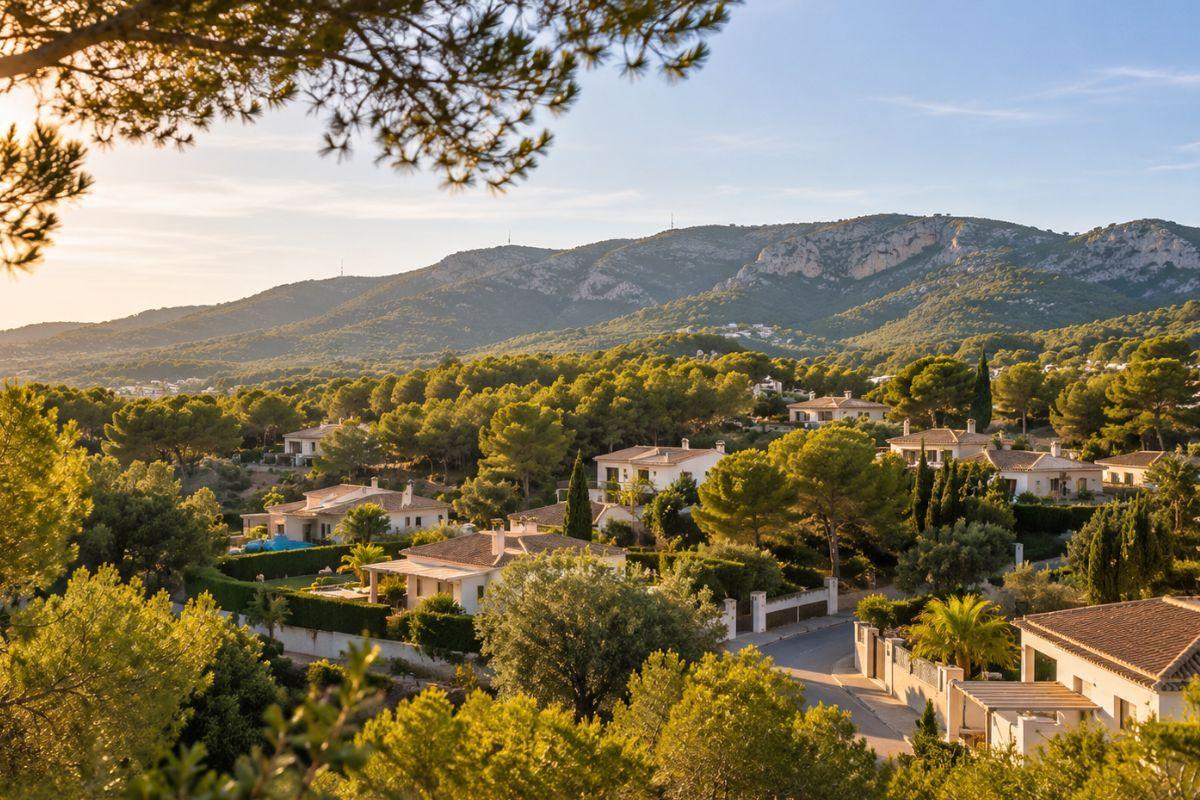
Living in Canyelles or Olivella means living in a house with a garden or a plot of land in the inland Garraf, between Vilanova i la Geltrú, Sitges and the Alt Penedès. Almost everyone in both municipalities lives on a residential development (urbanització) and neither has a train station, so the car is part of everyday life. In exchange, the price per square metre is lower than on the coast and the hills start within the municipality itself.
Here is what is worth knowing before you buy or move to Canyelles or Olivella: prices, residential developments, transport, schools and services.
Key points
Price. Between July 2025 and June 2026, second-hand homes sold for an average of €2,194 per built m² in Canyelles and €1,724 per m² in Olivella, compared with €2,795 per m² in Vilanova.
Developments with works still to do. In Les Palmeres (Canyelles) owners pay for the development works in phases, and in Olivella, Mas Milà and Plana Novella still have their land readjustment (reparcel·lació) pending.
No train. The nearest stations are in Vilanova, Sitges and Vilafranca. Canyelles has a bus to Vilanova every half hour; Olivella has few buses and none on Sundays.
Primary and secondary school in the municipality. For batxillerat (ages 16 to 18) and for hospital care you need to go to neighbouring towns.
Protected nature. Olivella lies within the Parc del Garraf and Canyelles is part of the Parc d'Olèrdola.
How much does a house cost in Canyelles and Olivella?
According to the property sales statistics of the Departament d'Habitatge, which publishes the Land Registrars' data, second-hand homes sold at these average prices between July 2025 and June 2026. For comparison, we include the three nearest coastal municipalities:
| Municipality | Second-hand (€ per built m²) | Homes sold in a year |
|---|---|---|
| Olivella | €1,724 | 97 |
| Canyelles | €2,194 | 104 |
| Vilanova i la Geltrú | €2,795 | 1,456 |
| Sant Pere de Ribes | €2,840 | 569 |
| Sitges | €5,736 | 557 |
When comparing, bear in mind that almost everything sold in Canyelles and Olivella is a house, while on the coast there are many more flats, so the price per metre does not measure exactly the same thing. Within each municipality the differences are also large: the price of a house depends above all on the development, the size of the plot, whether it has a pool and its condition. You can find these figures for the whole area, updated every quarter, in our housing market report.
The residential developments: where people live in Canyelles and Olivella
In both municipalities the old village is small and most of the population lives on developments spread across the municipal area. Knowing which one a house is on matters as much as knowing the municipality: it determines which bus stops are nearby and whether there are development works still to be paid for.
Canyelles
According to the gazetteer of Idescat, the Catalan statistics institute, the settlements with the most residents are Califòrnia (1,600 residents), the village itself (1,496) and les Palmeres (1,339). The rest live in Vora Sitges, Can Roca, Nou Canyelles, la Cogullada, les Amèriques and Daltmar, and in farmhouses (masies) spread across the municipality. Almost everything is terraced, semi-detached or detached houses, many with a shared pool.
Olivella
413 people live in the old village and its surroundings; the other 4,060 residents live on the five developments listed by the Ajuntament d'Olivella (the town council): Can Surià, La Plana Novella, Les Colines, Mas Mestre and Mas Milà. They are houses on plots among pine trees, many with a pool. Mas Milà has most of the local facilities, including the school and the health centre.
What to check before buying on a residential development
In both municipalities there are developments that are still completing their services, and that can mean charges for the owners.
Canyelles. In Les Palmeres, the town council carries out the development works in phases and the owners pay for them through development charges (quotes urbanístiques). The latest, the drinking water network for the third sector, received final approval in October 2025, according to the notice in the provincial official gazette.
Olivella. According to the town council's planning information, Can Surià, Les Colines, Can Milà and Mas Mestre are fully consolidated urban land, while Mas Milà and Plana Novella still have their land readjustment projects and remaining works pending. In Plana Novella the readjustment is a financial one: the development costs are shared among the owners of the plots, and street lighting is still to be resolved.
Sewage in Olivella. It is generally individual, with a septic tank, except in Can Milà and some parts of Mas Milà and Mas Mestre.
Before buying, ask the town council whether the plot has any pending or planned development charges and what its sewage system is. And if you are selling, it is worth having that information to hand before putting the house on the market.
How do you get to Vilanova, Sitges and Barcelona?
Neither municipality has a train station. The nearest are in Vilanova i la Geltrú, Sitges and Vilafranca del Penedès. From Vilanova and Sitges runs the Rodalies R2 Sud line: according to Renfe's timetables, Vilanova to Barcelona-Sants takes 42 to 47 minutes, and Sitges, 35 to 41. At peak times a train leaves Vilanova for Barcelona roughly every quarter of an hour.
From Canyelles
The L68 bus line Vilanova–Canyelles–Olèrdola–Vilafranca runs about 28 trips in each direction on weekdays, roughly every half hour: towards Vilanova, the first leaves Canyelles at 6:40 and the last at 22:10. Direct trips take 25 to 30 minutes to Plaça Eduard Maristany, next to Vilanova station; some go via Sitges and take considerably longer. Adding bus and train, allow about 70 to 80 minutes to Barcelona-Sants, not counting waiting time. By car, Vilanova is very close via the C-15, which also leads to the C-32 towards Barcelona.
From Olivella
The only line is the 76, Vilafranca del Penedès–Sitges via Olivella. On weekdays it runs five trips towards Sitges and four towards Vilafranca; on Saturdays, two in each direction, and there is no service on Sundays. It stops in Can Surià, Les Colines, Mas Milà and Mas Mestre, but not in Plana Novella. From Mas Milà to Sitges station takes 32 to 36 minutes. In August 2026 the town council asked the Generalitat for more trips and a weekend service. With these timetables, a car is essential: by road you quickly reach Sitges and the C-32, and there are direct roads to Sant Pere de Ribes and Canyelles.
In the integrated fare system, Olivella is in zone 3, like Sitges, and Canyelles in zone 4, like Vilanova.
Schools in Canyelles and Olivella
According to the schools directory of the Departament d'Educació for the 2026-2027 school year, both municipalities have a state primary school, secondary school and nursery:
| Municipality | State schools |
|---|---|
| Canyelles | Escola Sant Nicolau (early years and primary), Institut Pla del Bosc (ESO, secondary for ages 12 to 16) and llar d'infants (nursery) Els Patufets II |
| Olivella | Institut Escola El Morsell (early years, primary and ESO in the same school) and llar d'infants El Castellot |
Neither offers batxillerat. Canyelles town council says there are midday buses for secondary students who go to Vilanova or Vilafranca.
Doctor, shopping and everyday services
Primary healthcare is in the municipality itself: Canyelles has a local ICS clinic (the Catalan public health service) that reports to CAP Roquetes in Sant Pere de Ribes, and Olivella has its own primary care centre on Avinguda Mas Milà. For hospital care, the reference is Vilanova, Sant Pere de Ribes or Vilafranca. Since April 2026, Canyelles has also had a direct bus line to the area's hospitals, with five services a day in each direction.
Canyelles has a municipal market and local shops, such as a pharmacy and a bakery. In Olivella, the main shopping street is in Mas Milà and Can Milà, and the municipality has a public swimming pool, a football pitch, a cultural centre, a social centre for older people and a youth information point. For bigger shopping, leisure and much of the paperwork, everyday life relies on Vilanova, Sitges, Sant Pere de Ribes and Vilafranca.
Nature: the Parc del Garraf and the Parc d'Olèrdola
Olivella is one of the nine municipalities in the Parc del Garraf, managed by the Diputació de Barcelona, with more than 12,000 protected hectares. You can walk or cycle in the park without leaving the municipality; on the village's Plaça Major, La Sala gives information about the park on weekend and public holiday mornings.
Canyelles is not in the Parc del Garraf, but together with Olèrdola it is part of the Parc d'Olèrdola.
Who does living in Canyelles or Olivella suit?
Families looking for a house with a garden who can organise themselves around the car for secondary school, after-school activities and shopping.
People who work from home or work in the Garraf or the Penedès and don't need to take the train every day.
People who want more space for their money than on the coast and don't need to walk to the beach.
Walkers and cyclists who want the Garraf without leaving the municipality.
It suits you less if you want to walk to the beach, the train or the shops, or if nobody at home drives, especially in Olivella. In that case, compare it with living in Sitges or in Vilanova i la Geltrú. And if you want to know what buyers in the area are asking for today, we explain it in what home buyers in the Garraf are looking for.
If you have a house in Canyelles or Olivella and you are thinking of selling it, we can value it using real sales in the area and explain how we would sell it.
Keep reading
Still have a question?
Ask us anything about your home or the one you're looking for. When you call, one of us will answer: Ariadna or Xavier.