Living in Calafell: prices, trains, schools and checks before buying
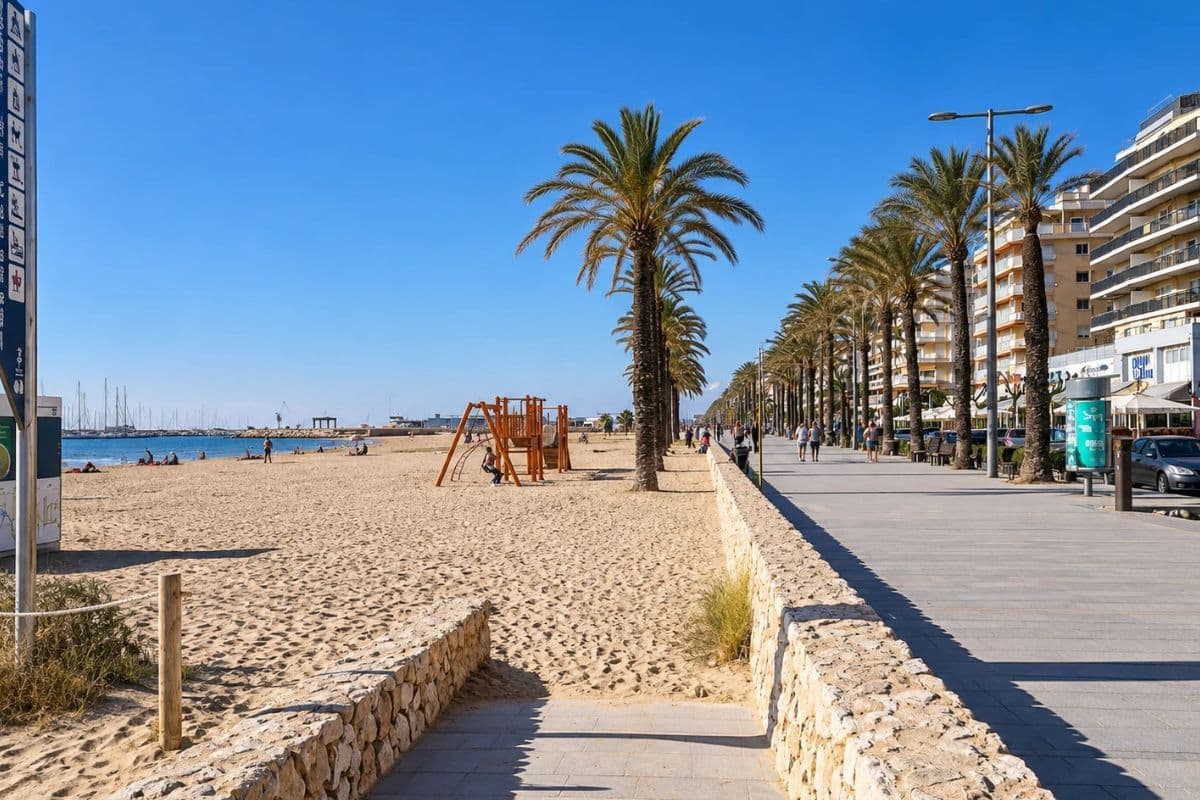
Living in Calafell: price per square metre, trains to Barcelona and Vilanova, schools, second homes and what to check before buying a house.
Living in Calafell means living on the Baix Penedès coast, already within the province of Tarragona, in a municipality of just over 32,000 people spread across three centres: the old village, inland; La Platja de Calafell; and Segur de Calafell, home to half the population. It has two stations on the R2 Sud line, about five kilometres of beach and services open all year round. And there is one feature worth knowing before you buy: more than half of its homes are not a main residence.
Here is what is worth knowing before you buy or move to Calafell: prices, neighbourhoods, transport, schools, healthcare and what to check before signing.
Key points
Price. Between July 2025 and June 2026, second-hand homes sold for an average of €2,506 per built m², almost the same as in Cunit and about €280 less per metre than in Cubelles or Vilanova.
Segur is home to half the residents. The rest live in the village, in La Platja and on residential developments (urbanitzacions) such as Mas Mel, Calafell Residencial or Mas Romeu.
A train every half hour. From Calafell you reach Barcelona-Sants in just under an hour and Vilanova in 14 minutes; from Segur, about three minutes sooner.
Lots of second homes. Only 43.6 % of homes are a main residence, and over the course of the year the population is equivalent to 26 % more than the number of registered residents.
Services in the municipality. State primary and secondary schools offering batxillerat (ages 16 to 18), a CAP (primary care centre) with 24-hour urgent care and a municipal market. The nearest hospital is the one in El Vendrell.
Regulated rentals and tourist flats. Calafell is a stressed residential market area, and tourist use requires a prior planning licence.
How much does a house cost in Calafell?
According to the property sales statistics of the Departament d'Habitatge, which publishes the Land Registrars' data, second-hand homes sold at these average prices between July 2025 and June 2026, shown here alongside the neighbouring coastal municipalities:
| Municipality | Second-hand (€ per built m²) | Homes sold in a year |
|---|---|---|
| Calafell | €2,506 | 1,060 |
| El Vendrell | €2,054 | 1,028 |
| Cunit | €2,470 | 478 |
| Cubelles | €2,778 | 424 |
| Vilanova i la Geltrú | €2,795 | 1,456 |
After Vilanova, Calafell is the municipality on this stretch of coast where the most homes are sold: 1,060 in a year, slightly more than in El Vendrell, which has more inhabitants. Within the municipality the price varies a great deal depending on the area, the street and the condition of the property. You can find the figures for the whole area, updated every quarter, in our housing market report.
The village, La Platja or Segur: where to live in Calafell?
According to the gazetteer of Idescat, the Catalan statistics institute (2025 municipal register), Segur de Calafell has 16,557 residents; the village centre, 4,807; and La Platja de Calafell, 4,481. The rest live on residential developments, the most populated being Mas Mel (2,295), Calafell Residencial (1,481), Mas Romeu (815) and Calafell Parc (541).
Calafell village. The old centre, inland, around the Castell de la Santa Creu.
La Platja de Calafell. The neighbourhood between the railway line and the seafront promenade, with the municipal market. Its main streets are a restricted access zone: only authorised vehicles can drive in.
Segur de Calafell. The largest centre, with its own station, the marina, its health centre and the Institut La Talaia secondary school.
The residential developments. The POUM (the municipal urban plan) describes a low-density municipality, with developments dating from the 1960s. If the house is on one of them, check which urban bus stop is nearby.
According to the 2021 Census, almost one in three main residences has 60 m² of usable floor area or less.
Can you live in Calafell all year round?
Yes, but it is worth knowing what it is like outside the summer. According to the 2021 Census figures published by Idescat, of Calafell's 27,112 family dwellings, 11,820 are a main residence; the rest are second homes or empty. And in 2024 the average population over the year was 26 % higher than the resident population:
| Municipality | Homes that are a main residence (2021) | Average population over the year compared with residents (2024) |
|---|---|---|
| Calafell | 43.6 % | +26 % |
| Cunit | 44.5 % | +19 % |
| El Vendrell | 50.3 % | +19 % |
| Cubelles | 60.8 % | +4 % |
| Vilanova i la Geltrú | 78.6 % | −2 % |
If you are going to live there all year, visit the property out of season too: see how many neighbours live in the building during the winter, which shops stay open nearby and how the community of owners is managed.
How do you get to Vilanova and Barcelona from Calafell?
The municipality has two stations on the Rodalies R2 Sud line (commuter rail): Calafell and Segur de Calafell. According to Renfe's timetables, a train leaves for Barcelona every half hour throughout the day, weekends included. On weekdays, the first leaves Calafell at 5:23 and the last at 22:02; on the way back, the last leaves Barcelona-Sants at 23:06.
| Destination | From Calafell | From Segur de Calafell |
|---|---|---|
| Vilanova i la Geltrú | 13-14 minutes | 10-11 minutes |
| Barcelona-Sants | 57-62 minutes | 54-59 minutes |
| Barcelona-Passeig de Gràcia | 63-68 minutes | 60-65 minutes |
The regional trains that stop in Vilanova and Sant Vicenç de Calders do not stop in Calafell or Segur, so there is one train every half hour at peak times too. In the integrated fare system, Calafell is in zone 5, like Cunit; Cubelles and Vilanova are in zone 4.
By bus and by car
Urban bus. The three lines of Calafell's urban bus service run every day, with one bus an hour on each line, from roughly 5 in the morning to midnight. Line L3 links the two stations and passes both health centres. A single ticket costs €1.65.
Vilanova–El Vendrell. The Bus Garraf line stops in Segur and at Calafell station: every half hour on weekdays and 11 trips in each direction at weekends and on public holidays. One in two weekday trips goes via the Hospital del Vendrell.
Calafell–Barcelona. A direct bus Monday to Friday, excluding public holidays, with about a dozen departures in each direction. The first leaves Calafell village at 6:20 and arrives at Plaça d'Espanya at 7:45.
By car, the C-31 links it with El Vendrell and Vilanova, and there is access to the C-32 and the AP-7.
Primary and secondary schools in Calafell
According to the schools directory of the Departament d'Educació for the 2026-2027 school year, all the primary and secondary schools in the municipality are state schools:
| Stage | State schools |
|---|---|
| Early years and primary | Castell de Calafell, Santa Creu de Calafell and Vilamar, in Calafell; La Ginesta and Mossèn Jacint Verdaguer, in Segur |
| ESO (secondary for ages 12 to 16), batxillerat and vocational training (FP) | Institut Camí de Mar, in Calafell, with intermediate and higher-level vocational training, and Institut La Talaia, in Segur, with intermediate vocational training |
| Ages 0 to 3 | El Petit Príncep (Calafell Parc), Els Terrossets (Calafell), El Petit Trenet and El Rasclet (Segur) |
Batxillerat can be completed without leaving the municipality.
Doctor, hospital and shopping
The CAP de Calafell, run by the Xarxa Santa Tecla, is open Monday to Friday from 8:00 to 20:00 and has 24-hour urgent care every day. Segur has its own health centre, open Monday to Friday. The nearest hospital is the Hospital del Vendrell, also run by the Xarxa Santa Tecla, about 17 minutes by bus from Calafell station.
The municipal market is in La Platja de Calafell and opens Monday to Saturday. There is a weekly market on Tuesdays in Calafell and on Fridays in Segur, on the seafront promenade.
What to check before buying in Calafell
If you plan to rent it out by the day. Calafell is listed in the annex to Decree-Law 3/2023 on homes for tourist use: you need a prior planning licence, valid for five years, and the municipal plan must allow that use. Homes already authorised need this licence before November 2028 to carry on.
If you plan to rent it out as a main residence. Calafell is on the list of municipalities declared stressed residential market areas, where rents are regulated. According to Idescat, the average rent on contracts signed in 2025 was €708 a month.
Planning changes under way. During 2026 the Ajuntament (town council) has suspended licences in several areas while it prepares changes to the POUM: Segur de Dalt and Les Brises, the Turó dels Sants, the Louie Vega sector and the Maresme and Andalusia streets. In some of them, the suspension also covers renovation works. If you are interested in a house or a plot in those areas, check the town council's planning changes under way first.
Commercial premises in Segur and La Platja. Since September 2026, and for one year that can be extended, no licences are being granted for convenience stores, takeaway food, call shops, mobile phone shops or ground-floor storage units in the centre of Segur and in La Platja.
If you are selling, it is worth having this information to hand: anyone thinking of renting out the property will ask you about it.
Who does living in Calafell suit?
People who want to live near the beach all year round with schools, a secondary school, a health centre and the train in the municipality itself.
People who work in Vilanova, El Vendrell or the Penedès: Vilanova is a quarter of an hour away by train.
People who work from home or go to Barcelona only a few days a week.
People looking for a few more square metres for the same budget as in Cubelles or Vilanova.
People looking for a second home with a direct train to Barcelona.
It suits you less if you go to Barcelona every day and need more trains at peak times, or if you prefer a street where almost all the neighbours live all year round. In that case, compare it with living in Vilanova i la Geltrú or in Cubelles, where more homes are main residences. If you are weighing up municipalities on this coast, also read living in Cunit.
If you have a house in Calafell and you are thinking of selling it, we can value it using real sales in the area and explain how we would sell it.
Keep reading
Still have a question?
Ask us anything about your home or the one you're looking for. When you call, one of us will answer: Ariadna or Xavier.