Municipal capital gains tax when selling a home in Catalunya: how it's calculated and who pays it
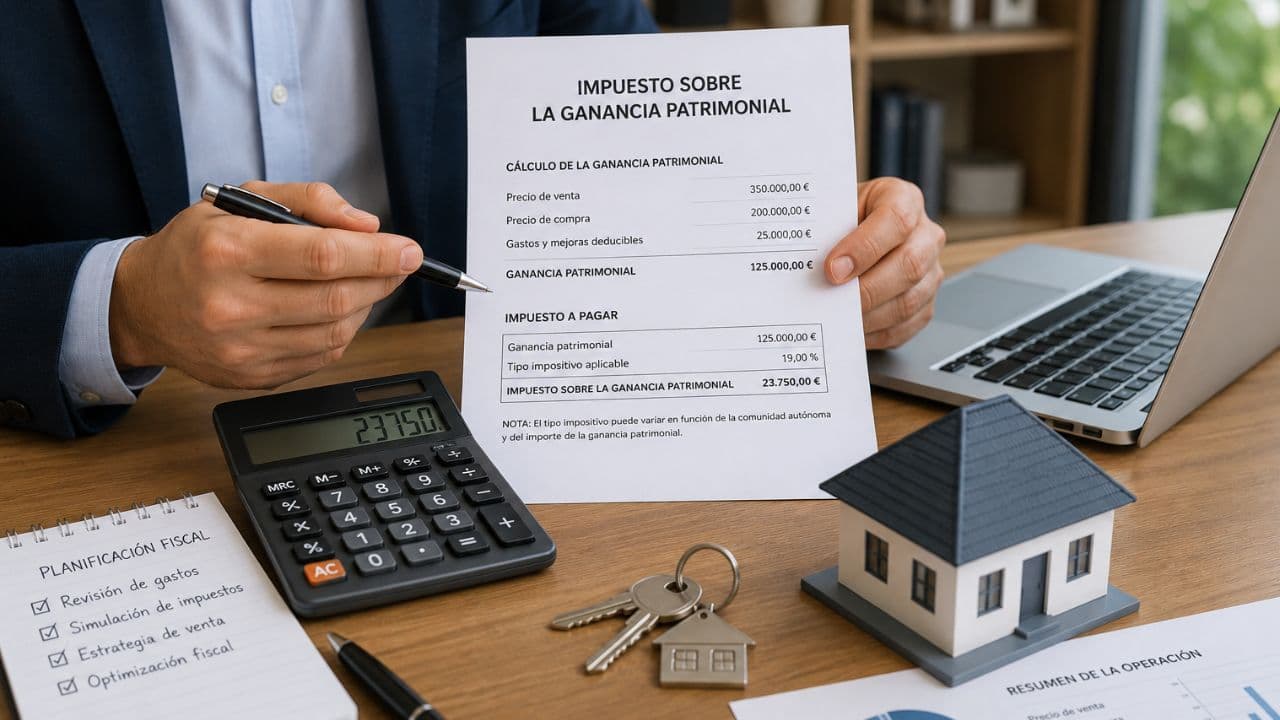
Who pays municipal capital gains tax when selling in Catalunya, how it's worked out and deadlines. 2026 table and Vilanova i la Geltrú steps.
If you're selling in Vilanova i la Geltrú, we'll work out what you'll keep in your own case: ask for a free valuation, or see how we sell in Vilanova.
Selling in Vilanova i la Geltrú? Below you will find the deadlines, the 2026 table and how the tax is filed there.
Key points
It taxes the land, not the home. It is a municipal tax on the increase in value of the urban land from when you bought the home until you sell it; the building itself does not count.
In a sale, the seller pays. In an inheritance the heir pays it and, in a gift, the person receiving the home.
There are two methods; you choose the more favourable one. The objective method uses the cadastral value of the land and the years of ownership; the actual gain method, the difference between the purchase and sale prices.
If you sell at a loss, you do not pay. But you must declare the sale as “not subject to tax” and provide the purchase and sale deeds.
The deadline is 30 working days from the deed. In an inheritance it is six months from the date of death, extendable in some cases. Filing late can lead to surcharges, late-payment interest and possible penalties.
In Vilanova i la Geltrú you file it yourself. It is a self-assessment (autoliquidación) and you must file one for each property: a flat, a parking space and a storage room count as three, even if they are in the same deed.
What is municipal capital gains tax when selling a home in Catalunya?
The municipal capital gains tax (plusvalía municipal) when selling a home in Catalunya is one of the taxes that raises the most questions among owners who are thinking of selling their property.
Its official name is the Tax on the Increase in Value of Urban Land (IIVTNU), and it taxes the increase in value that urban land has undergone from the moment the owner acquired the home until they transfer it.
Although people commonly talk about the “capital gain on the home”, the tax does not actually apply to the building, only to the value of the land on which the property stands.
This tax is managed by each town council, and the conditions may vary slightly depending on the municipality where the home is located.
Who pays municipal capital gains tax when selling a home in Catalunya?
In a standard sale, the municipal capital gains tax when selling a home in Catalunya is paid by the seller.
In other words, the person transferring the property is the one who must file the self-assessment or declaration and pay the tax within the deadline set by the town council.
However, there are exceptions:
In an inheritance, the heir pays it.
In a gift, the person receiving the home pays it.
If the seller lives abroad, certain obligations may fall on the buyer.
For this reason, it is important to look at each transaction individually before signing.
How is municipal capital gains tax calculated?
Following the legislative changes approved in recent years, there are now two calculation methods.
The taxpayer can choose whichever is more favourable.
Objective method
This is the most widely used system.
It is calculated by applying coefficients approved by each town council to the cadastral value of the land and the number of years since the purchase.
The formula may vary depending on the municipality, but essentially the following are taken into account:
Cadastral value of the land.
Years the property has been owned.
Maximum coefficients set by national legislation.
Tax rate approved by the town council.
Actual gain method
The taxpayer can opt for this system when the actual gain obtained is lower than the result of the objective method.
In this case, the following are compared:
Purchase price.
Sale price.
Percentage corresponding to the value of the land.
If the actual gain is lower, this option can be used to reduce the amount of the tax.
The rules are set out in articles 104 to 110 of the Local Taxation Act (Ley reguladora de las Haciendas Locales) and, in each municipality, in its local tax bylaw. If you are selling in Vilanova i la Geltrú, you will find the 2026 one below.
Do you have to pay municipal capital gains tax if you sell at a loss?
No.
This is one of the most important changes introduced in recent years.
If it can be shown that there has been no increase in value between the purchase and the sale, no tax liability arises.
For example:
You bought a home for 250.000 €.
You sell it for 230.000 €.
As there is a financial loss, no municipal capital gains tax should be paid.
To do this, you must declare the sale as “not subject to tax” and provide the purchase and sale deeds.
What is the deadline for paying municipal capital gains tax?
As a general rule, the seller has:
30 working days from the signing of the sale deed.
In the case of an inheritance, the deadline is usually extended to six months from the date of death, and can be extended further in certain circumstances.
The plusvalía is not the only thing left to do after signing: the meters, the home insurance, the IBI and notifying the homeowners' association are covered in what to do after selling a flat.
Each town council may set specific procedures for filing the declaration. In Vilanova i la Geltrú, the deadlines and how to file are set out below.
What happens if it is not paid?
Failing to file within the deadline can lead to:
Surcharges.
Late-payment interest.
Possible tax penalties.
That is why it is advisable to check this obligation before signing the sale and not leave it to the last minute.
The relationship between municipal capital gains tax and personal income tax (IRPF)
A common mistake is to confuse municipal capital gains tax with the capital gain that is declared on your income tax return.
They are completely different taxes:
Municipal capital gains tax is collected by the town council.
The capital gain is taxed under personal income tax (IRPF) with the Tax Agency.
Therefore, selling a home can involve both taxes at the same time.
If you would like to know about other costs associated with a sale, you can read our article on selling a home in Catalunya: taxes and costs you need to know about.
You may also be interested in selling a house with an outstanding mortgage: options and legal steps in Catalunya.
Are there any reductions or exemptions?
Yes.
Depending on the municipality, there may be reductions in certain cases, especially in transfers on death between close family members.
In addition, there is no obligation to pay when:
There is no increase in value.
The transaction is covered by certain legal exemptions.
Since each case may have its own particularities, it is advisable to seek advice before doing any calculation.
Municipal capital gains tax in Vilanova i la Geltrú: what changes if you sell here (2026)
The law is national, but each town council sets the coefficients, the tax rate and the reductions in its local tax bylaw. In Vilanova i la Geltrú it is Ordenança fiscal núm. 6 for 2026. This is what it says.
Who pays and by when
Sale: the seller pays. You have 30 working days from the signing of the deed.
Inheritance: the heirs pay. They have 6 months from the date of death, which can be extended to one year if the extension is requested before the 6 months are up, with the death certificate. If the Town Council does not reply within a month, the extension is deemed granted. Late-payment interest is charged during the extension.
Gift: the person receiving the home pays, within 30 working days.
If the seller is not resident in Spain, the buyer is liable for the tax instead.
Notaries send the Town Council a list of signed deeds every quarter: the Town Council knows a sale has taken place even if you do not declare it.
How to file in Vilanova
In Vilanova, the tax is a self-assessment (autoliquidación): you file it and pay within the same deadline. You must file one for each property: a flat, a parking space and a storage room count as three, even if they are in the same deed.
Online: on the Town Council's electronic office, with idCAT Mòbil, Cl@ve or a digital certificate.
By email: you send the scanned deed to gestiotributaria@vilanova.cat. The Town Council calculates the tax and sends you back the payment slip (except for companies and others required to file online).
In person: at the Oficina de Gestió Tributària (Plaça de la Vila, 8). It is best to call 93 814 00 00 (extension 2610) first, Monday to Friday from 9:30 to 14:00.
Documents required: the deed, the latest property tax (IBI) bill (or a location plan) and proof of any exemption or reduction you are claiming.
How to pay: by card at the municipal collection office or at partner banks, on the town council website, through online banking or by transfer quoting the reference. This tax cannot be paid by direct debit. According to the municipal electronic office, it can only be deferred or paid in instalments for inheritances and gifts. If the debt moves to the enforcement stage, it is handled by the Organisme de Gestió Tributària of the Diputació de Barcelona.
How it is calculated in Vilanova
There are two methods and whichever gives the lower amount is applied.
1. Objective method (the usual one):
cadastral value of the land × coefficient by years × tax rate
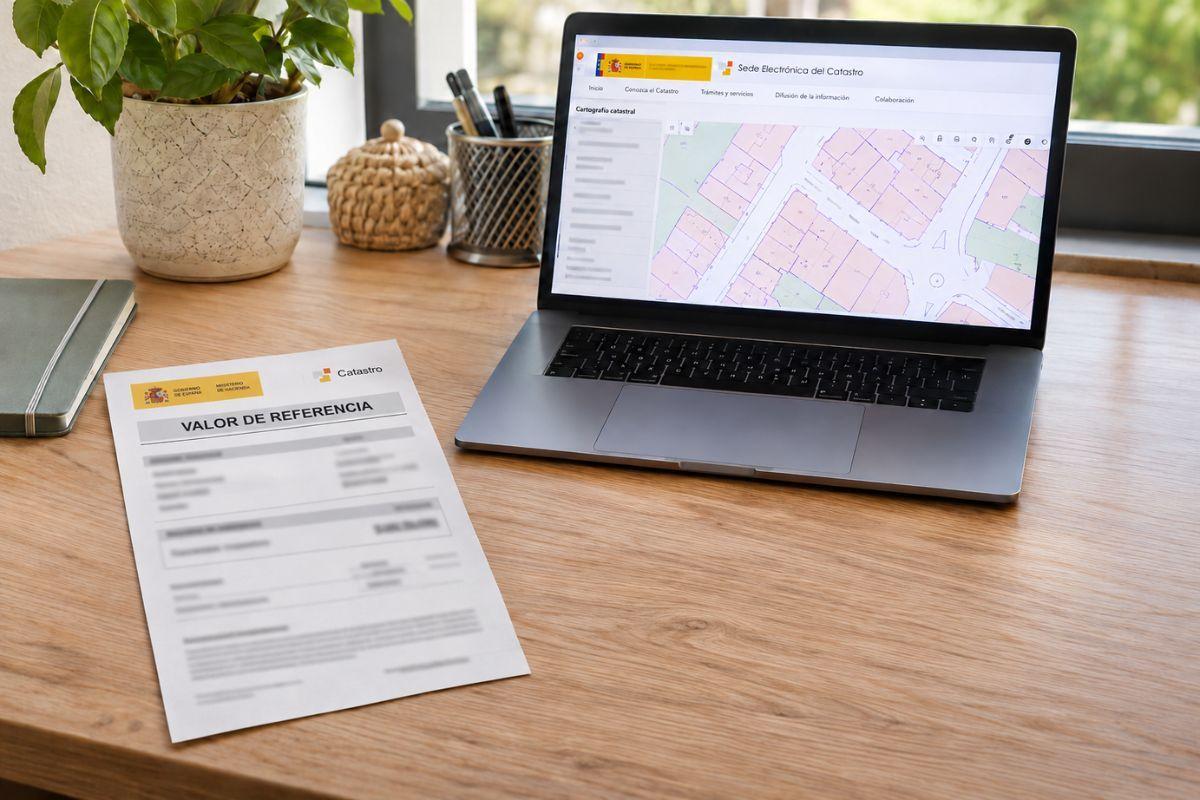
The cadastral value of the land appears on the property tax (IBI) bill and on the Cadastre's electronic office. It is the value of the land only, not of the whole flat. Years are counted as whole years, up to a maximum of 20.
Coefficient and rate in Vilanova's 2026 bylaw, with the result of multiplying them: the percentage of the cadastral value of the land that you would pay before reductions.
Less than 1 year: coefficient 0,14 (pro-rated by months) · rate 20,65 % → up to 2,89 %
1 year: 0,13 · 20,60 % → 2,68 %
2 and 3 years: 0,14 · 20,60 % → 2,88 %
4 years: 0,16 · 20,60 % → 3,30 %
5 years: 0,17 · 20,60 % → 3,50 %
6 years: 0,16 · 21,65 % → 3,46 %
7 years: 0,1307 · 30 % → 3,92 %
8 years: 0,1089 · 30 % → 3,27 %
9 years: 0,0981 · 30 % → 2,94 %
10 to 13 years: 0,0871 · 30 % → 2,61 %
14 and 15 years: 0,09 · 30 % → 2,70 %
16 years: 0,10 · 30 % → 3,00 %
17 years: 0,13 · 30 % → 3,90 %
18 years: 0,17 · 30 % → 5,10 %
19 years: 0,23 · 29,42 % → 6,77 %
20 years or more: 0,40 · 24,78 % → 9,91 %
These coefficients have been in force since 28 January 2026. The State tried to change the maximum coefficients twice this year, with effect from 1 January and from 1 December, and both times Congress repealed the royal decree-law (27 January and 2 October). As of 5 October 2026, this table remains valid.
2. Actual gain method (you request it if it works out lower):
You subtract the purchase price from the sale price, as shown in the deeds (or the value verified by the tax authorities, if higher). Costs and taxes are not deducted.
You apply to that difference the percentage that the land represents of the total cadastral value (shown on the property tax bill).
If you inherited the home or it was gifted to you, the purchase value is the one declared for inheritance or gift tax, which in Catalunya is managed by the Agència Tributària de Catalunya.
If you sell for less than it cost you, there is no capital gains tax. But you must declare the sale as “not subject to tax” and provide both deeds.
Examples (made-up figures to explain the calculation; they are not data from any actual home):
12 years of ownership. Cadastral value of the land of 40.000 €. You bought for 150.000 € and sell for 230.000 €; the land is 40 % of the cadastral value. Objective method: 40.000 × 0,0871 = 3.484 € taxable base × 30 % = 1.045,20 €. Actual gain method: (230.000 − 150.000) × 40 % = 32.000 € taxable base. You go with the objective method, which is lower.
2 years of ownership. Same land. You bought for 200.000 € and sell for 205.000 €. Objective method: 40.000 × 0,14 = 5.600 € × 20,60 % = 1.153,60 €. Actual gain method: (205.000 − 200.000) × 40 % = 2.000 € × 20,60 % = 412 €. Here it is worth requesting the actual gain method.
Inheritances: Vilanova's reduction and its conditions
If you inherit the home, the Town Council reduces the tax by 95 % for the spouse and by 85 % for children and parents (including adopted children and adoptive parents). All of these conditions must be met:
The home is, or will be, your main residence. It can include up to two parking spaces and a storage room in the same building.
You own no other property in your name, whether full ownership, usufruct, bare ownership or a share.
Those properties add up to more than 80 % of the inheritance.
You do not sell it within 3 years of the death.
To put it plainly: if you inherit a home in order to sell it, this reduction will normally not apply.
Capital gains tax is not inheritance tax. They are two different taxes, with the same 6-month deadline: capital gains tax goes to the Town Council and inheritance tax goes to the Agència Tributària de Catalunya.
Cases that do not pay capital gains tax (and that we often see)
Siblings who inherit a flat and one keeps it by paying the others. If the co-ownership of a home that cannot be divided is dissolved and the whole property is awarded to one of the co-owners, there is no capital gains tax. The years continue to count from the earlier purchase for when it is sold.
Divorce or separation. Transfers between spouses or to the children by a court ruling of annulment, separation or divorce are not taxed, whatever the couple's marital property regime.
Transfer in lieu of payment or mortgage foreclosure of the main residence. It is exempt, with conditions: having been registered as resident there for the previous two years and not having other assets with which to pay the debt.
Are you going to sell in Vilanova i la Geltrú and want to know what you will be left with? We will work it out for you with your deeds and your property tax bill before you put your home on the market.
Conclusion
The municipal capital gains tax when selling a home in Catalunya is a tax that affects most sales, although the amount will depend on the municipality, how long you have owned the property and the increase in value generated.
Knowing who has to pay it, how it is calculated and which exceptions exist helps you avoid mistakes and plan the sale of a home properly.
If you are thinking of selling your property and want to know all the costs involved in the transaction, at The Vila Home we can help you analyse your case and answer any questions before you put your home on the market.
Keep reading


Thinking of selling?
We call you, come and see it, and tell you what it's worth and how we'd sell it.