Catastro reference value: what it is and how it affects your sale
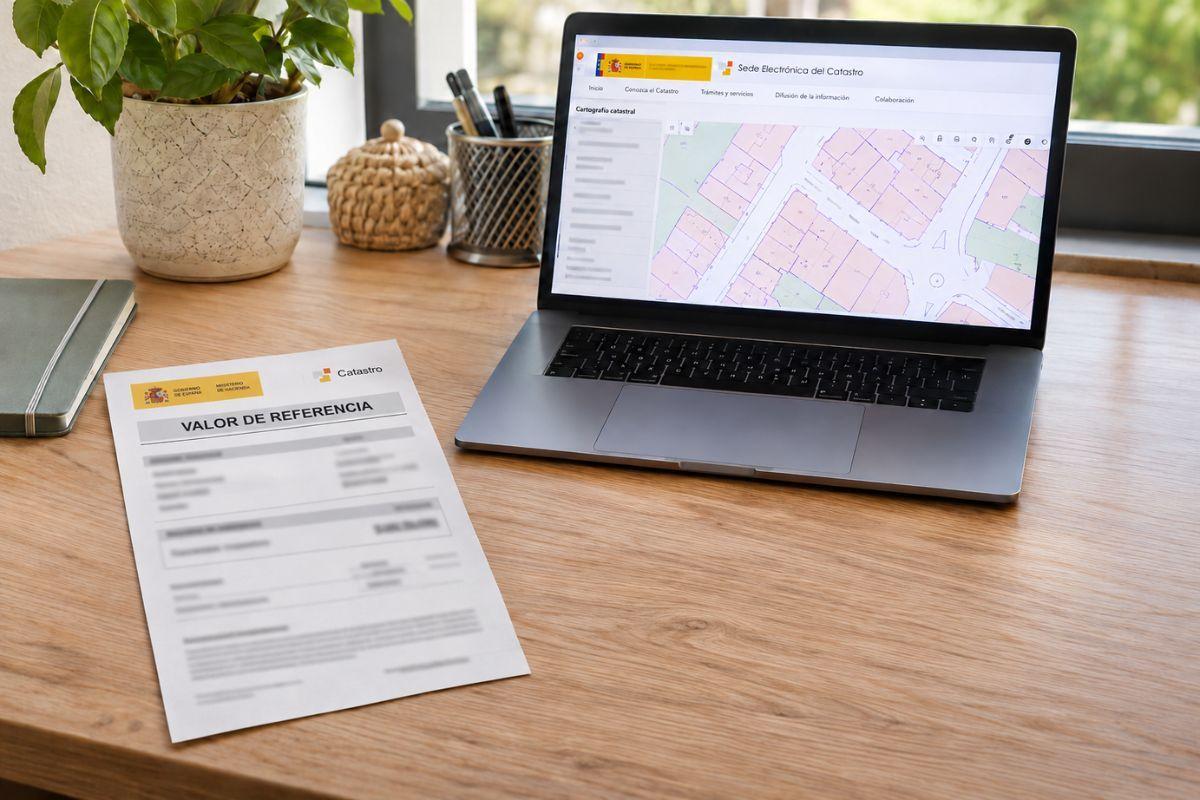
The Catastro reference value: what it is, why it isn't the cadastral value, how it affects the buyer's ITP in Catalunya and why not your income tax.
If you're selling in Vilanova i la Geltrú, we'll work out what you'll keep in your own case: ask for a free valuation, or see how we sell in Vilanova.
When you put your home on the market, sooner or later a figure turns up that you didn't choose: the Catastro's reference value (valor de referencia). The authorities set it for every property, it can be looked up and, in Catalunya, it marks the minimum on which the buyer pays tax on the purchase.
It isn't a sale price, nor a valuation of your flat. But it's worth knowing before you negotiate, because it explains why some buyers react the way they do to a price cut. Here's what it is, which taxes it counts for and which it doesn't.
The essentials
It's a value set by the Catastro. It's calculated every year from actual sales in the area, and a reduction factor of 0.9 is applied.
It isn't the cadastral value. The cadastral value (valor catastral) is used for the annual property tax (IBI); the reference value is used for the tax on the purchase, inheritance tax and gift tax.
In Catalunya it applies to property transfer tax (ITP). Someone buying a resale home pays tax on whichever is higher: the agreed price or the reference value.
It doesn't change your income tax (IRPF) or your municipal capital gains tax (plusvalía municipal). As the seller, you're taxed on the actual sale price and on the cadastral value of the land, not on the reference value.
It can only be challenged when the tax is paid. It can't be appealed when it's published; instead, you request a correction of the self-assessment (autoliquidación) or appeal the tax assessment (liquidación).
What is the reference value?
It's one more item in each property's cadastral description, like its floor area or use. It was introduced by Law 11/2021 into the consolidated text of the Cadastre Law (Ley del Catastro Inmobiliario) (art. 3.1 and third final provision) and has applied since 1 January 2022.
The Dirección General del Catastro, the government body that runs the Catastro, calculates it like this:
It collects the prices of the sales that notaries report.
It divides the area into homogeneous zones and publishes a value map with an average value for each zone.
It adjusts that average value to each property's features using the data held by the Catastro.
It applies a reduction factor of 0.9, set by Order HFP/1104/2021.
The law sets a limit: the reference value can't exceed market value. It's updated every year for all municipalities at once. The 2026 values have been available to look up since 1 January this year.
The Constitutional Court upheld the system in its ruling 13/2026 of 12 February, published in Spain's Official State Gazette (BOE) on 19 March 2026.
How is it different from the cadastral value and the sale price?
They're three different figures that are often confused:
| Figure | Who sets it | What it's for |
|---|---|---|
| Cadastral value | The Catastro, with periodic reviews | Basis for IBI and other taxes that use it, such as municipal capital gains tax |
| Reference value | The Catastro, every year | Minimum basis for ITP and for inheritance and gift tax |
| Sale price | Buyer and seller | What's actually paid; basis for the seller's income tax |
According to the Catastro's frequently asked questions, the reference value has no effect on IBI. Nor is it a valuation of your home: it's an average value for the area adjusted with registry data, and it can't see whether the flat has been renovated, has views or needs work. That's why it can end up above or below what people are actually paying on the market. If you want to understand the difference between the ways a home gets valued, we explain it in our article on appraisals and valuations.
How does it affect the buyer in Catalunya?
This is the key part. When buying a resale home, the buyer pays property transfer tax (ITP). The Law on Transfer Tax and Stamp Duty (ITP and AJD) says the tax base is the reference value, unless the agreed price or the declared value is higher, in which case the higher figure is used (art. 10.2).
Catalunya applies the same rule. The Agència Tributària de Catalunya (ATC, the Catalan tax agency) explains it this way for transfers since 1 January 2022: for ITP, tax is paid on the highest of the reference value, the declared value and the price. If the property has no reference value, the ATC applies its own criteria to check the value.
In practice:
If the agreed price is higher than the reference value, the buyer pays tax on the price. This is the usual case.
If the agreed price is lower, the buyer pays tax on the reference value. They pay ITP on an amount they never paid.
You'll find the ITP rates, and the reductions available to some buyers, in our article on ITP or VAT and in the one on reduced ITP in Catalunya.
And does it affect you, as the seller?
Not directly. Your two taxes on the sale are calculated with other figures:
Income tax (IRPF). The gain is calculated from the actual sale amount, unless it's below normal market value (IRPF Law, art. 35). The reference value doesn't appear in that calculation. We explain it in our article on income tax on the sale.
Municipal capital gains tax. It's calculated from the cadastral value of the land or, if you ask for it and can prove it, from the actual gain (Local Finance Law, TRLRHL, art. 107). It doesn't use the reference value either. You'll find it in our guide to municipal capital gains tax.
There's one case where it can reach you indirectly: if you inherited the home or it was given to you. The acquisition value you'll use for income tax is the one that results from the inheritance and gift tax rules, without exceeding market value (IRPF Law, art. 36). If the reference value was declared in the inheritance, that figure then counts when calculating your gain. If that's your situation, you'll want to read our article on selling an inherited flat.
Why does it matter in the negotiation?
Because buyers do their sums with ITP in mind. If the agreed price ends up below the reference value, the buyer pays the tax as if they'd paid more. In that range, a price cut doesn't save them any ITP.
This has two consequences for you:
A well-informed buyer can look up the reference value before making an offer and factor it into their budget.
If the buyer needs a mortgage, the bank will lend based on its own appraisal (tasación), not on the reference value. They're different things.
What doesn't make sense is setting your asking price by looking at the reference value. The price is set by the market: what's being paid for similar homes in your part of Vilanova i la Geltrú or the Garraf. The reference value is just one more figure in the sale that's worth knowing, so it doesn't take anyone by surprise when it's time to sign the deposit contract (arras).
How do you look it up?
On the Catastro's online portal (Sede Electrónica del Catastro), in the reference value section. You'll need the property's cadastral reference, which appears on the IBI bill.
To look up and certify a property's value on a specific date, you need to identify yourself with a digital certificate, electronic ID card (DNI electrónico) or Cl@ve, the government's online login system. Owners can also get a certificate with the data and technical details of the calculation. You can also request it through the Catastro's helpline (Línea Directa del Catastro) or at its regional offices (gerencias), by appointment.
A practical detail: the value that counts is the one in force on the date of the public deed. If you sign in January, the value may have changed from the one you checked in the autumn.
Can the reference value be challenged?
Yes, but not when it's published: only when the tax is paid (ITP and AJD Law, art. 10.3). The person who challenges it is the one paying ITP, that is, the buyer, and only after the purchase: according to the ATC, a prospective buyer can't contest it beforehand.
The options are:
Requesting a correction of the self-assessment for ITP, providing evidence that the reference value doesn't fit that particular home.
Appealing the tax assessment, if the ATC has issued one, through an appeal for reconsideration (recurso de reposición) or a claim before the economic-administrative tribunal (reclamación económico-administrativa).
In both cases, the authorities decide on the basis of a mandatory and binding report from the Catastro, which confirms or corrects the value (art. 10.4). Also, if the problem is that the Catastro's data on the home is wrong, such as the floor area or use, you can ask the Catastro to correct it.
This last point is in your hands as the seller: checking that your home's cadastral description is correct before you sell. If the square metres don't match reality, you'll want to read our article on building work without permits and square metres that don't add up.
If you're thinking of selling in Vilanova i la Geltrú or the Garraf and want to know your home's market price, we'll help you value it.
Keep reading



Thinking of selling?
We call you, come and see it, and tell you what it's worth and how we'd sell it.