Dissolution of joint ownership in Catalunya: when one co-owner keeps the home

Dissolution of joint ownership in Catalunya: how one co-owner keeps the home, the taxes, the mortgage and what to do if you can't agree.
If the inherited home is in Vilanova i la Geltrú or the Garraf, we can sell it for you: how we sell in Vilanova. And if you'd like to know what it's worth first, ask for a free valuation.
It's a very common situation: two siblings inherit their parents' flat, a couple bought a home half each, or two friends invested in a property together. Over time, one wants to keep it and the other would rather be paid their share. The way to settle it without selling to an outside buyer is a dissolution of joint ownership (extinción de condominio): one of the co-owners takes the whole property and compensates the others.
In Catalunya it is governed by the Civil Code of Catalunya (Codi civil), the Catalan Tax Agency (Agència Tributària de Catalunya, ATC) and, for the municipal capital gains tax (plusvalía), each local council. Here's how it works, which taxes apply and what the alternatives are if there's no agreement.
The essentials
What it is. The co-owners bring the joint ownership to an end: one keeps the property and pays the others the value of their share.
How it's done. By public deed before a notary, with everyone's agreement. Without agreement, any co-owner can ask a judge to order the division.
Regional tax. If there is no excess allocation (exceso de adjudicación), the person keeping the property pays stamp duty on documented legal acts (AJD) at 1.5% on the share they acquire.
Plusvalía and income tax (IRPF). In Vilanova i la Geltrú, allocating an indivisible property is not subject to plusvalía, and the Income Tax Act does not treat it as a sale, although the values are not updated.
The mortgage is a separate matter. The division doesn't affect the bank: for the person leaving to stop being a borrower, the lender has to agree to it.
What exactly is a dissolution of joint ownership?
When a home belongs to several people jointly and undivided (proindiviso), each owns a percentage (for example, 50%), but nobody owns any specific physical part of it. Book Five of the Civil Code of Catalunya calls this an ordinary undivided community (comunidad ordinaria indivisa) and presumes that the shares are equal unless proven otherwise (art. 552-1).
The community is dissolved, among other causes, when the common property is divided or when all the shares come together in one person (art. 552-9). A dissolution of joint ownership is exactly that: all the shares pass to one of the co-owners, who is the sole owner from the moment of signing (art. 552-12).
The three most common cases are:
Siblings who inherit. They have already accepted the inheritance and the property is in all their names, but only one wants to keep it. If you haven't accepted it yet, start with our article on selling an inherited flat.
Couples who separate. Divorce and the break-up of an unmarried partnership (pareja estable) have their own rules, which we explain in selling a flat in a divorce in Catalunya.
Co-owners who bought together. Friends, relatives or business partners who bought jointly and now want to go their separate ways.
Can I force the others to divide?
Yes. Any co-owner can demand division at any time and without giving reasons (art. 552-10.1). The only exception is if you have unanimously agreed not to divide for a set period, which cannot exceed ten years (art. 552-10.2).
A home can't be physically split without losing value. For these cases, the Civil Code provides that it goes to the co-owner who wants to keep it; if there are several, to the one with the largest share, and if the shares are equal, lots are drawn. Whoever keeps it pays the others the expert-appraised value (valor pericial) of their share. And if nobody wants it, it is sold and the price is shared out (art. 552-11.5).
There are two more rules worth knowing:
Anyone holding four-fifths or more can insist on keeping the whole property by paying the others the expert-appraised value of their shares (art. 552-11.4).
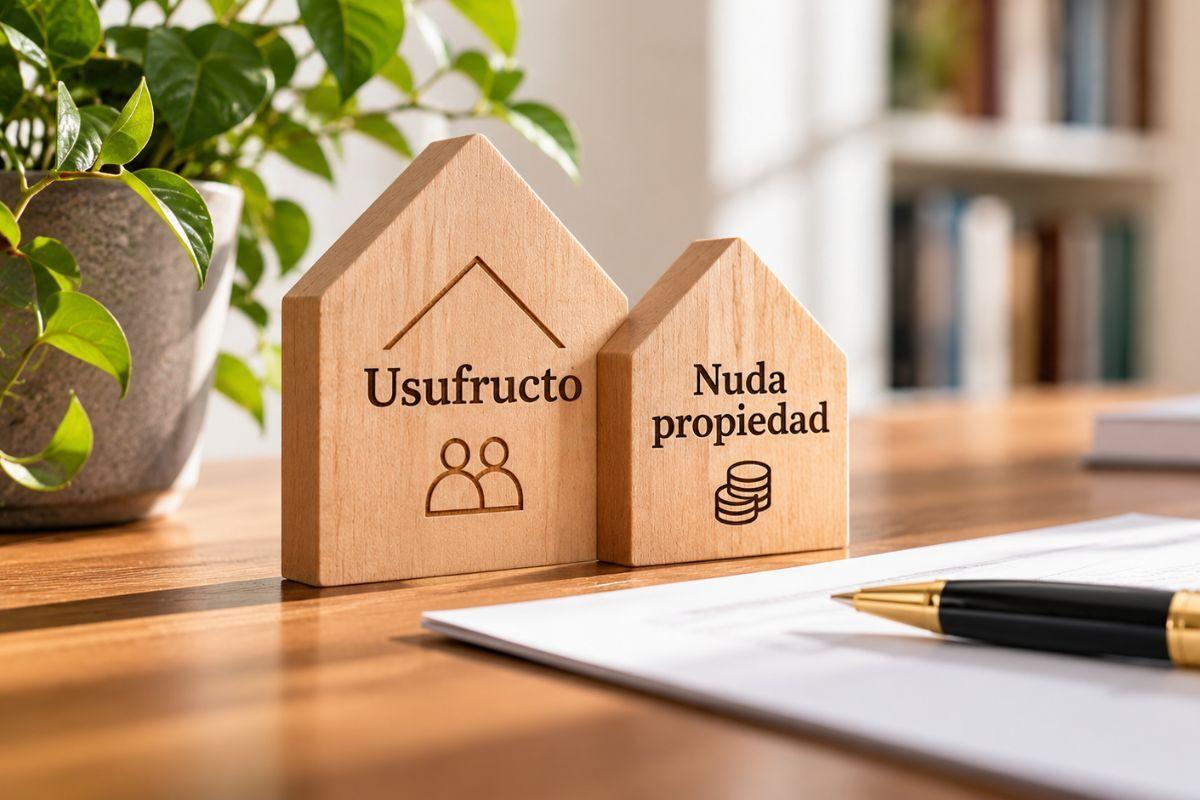
The division can also be made by giving some the usufruct (usufructo, the right to use it) and others the bare ownership (nuda propiedad; art. 552-11.3).
How it's done, step by step
Check the ownership. A land registry extract (nota simple) confirms whose name the property is registered in, in what percentages and what charges it carries.
Agree on the value. This is where families get stuck most often. The compensation should reflect the property's market price, not what each person hopes to get.
Talk to the bank if there's a mortgage. We cover this below, but it's best done before booking a date with the notary.
Sign the public deed. Before a notary, with all the co-owners. It sets out the allocation and how the compensation is paid.
Pay the taxes and register. The person keeping the property files form 600 (modelo 600) within one month of the deed and registers it in their name at the Land Registry.
What taxes are paid in Catalunya?
Stamp duty on documented legal acts (AJD). According to the Agència Tributària de Catalunya, allocating an asset when joint ownership is dissolved is taxed under AJD when it doesn't create an excess allocation liable to property transfer tax (ITP). It's paid by the person keeping the property, at 1.5%, and the taxable base is only the value of the share they acquire, not that of the whole property. It's filed with form 600 within one month of the date of the deed.
What if there's an excess allocation? There's an excess when someone receives more than their share entitles them to. The ATC handles it like this on its page on excess allocation:
If the excess is unavoidable, because the asset can't be divided or loses a lot of value when divided, and it is compensated in cash, it is not subject to property transfer tax.
If it isn't unavoidable, it is taxed as a property transfer for value (transmisiones patrimoniales onerosas), like a sale.
If there's no compensation, the ATC treats it as a gift and it is declared under gift tax (impuesto de donaciones).
The Civil Code itself says that what the person taking an indivisible home pays is considered neither a price nor an excess allocation (art. 552-11.5). Even so, the wording of the deed changes the tax, so it's worth having the notary or a gestoría (administrative and tax agency) work it out before signing.
Municipal capital gains tax. The municipal tax bylaw on plusvalía in Vilanova i la Geltrú declares that allocating the whole of a property to one of the co-owners, when a joint ownership over an indivisible property is dissolved, is not subject to the tax (art. 2.1.P). One thing to bear in mind: when the person who keeps it sells it in the future, the years will be counted from the previous acquisition, not from the dissolution (art. 2.2). If the property is in another municipality, check its bylaw. You'll find how the tax works in general in our article on the municipal capital gains tax.
Income tax (IRPF). The Income Tax Act states that there is no capital gain or loss when common property is divided or a community of property is dissolved, and adds that these operations cannot update the values of what is received (art. 33.2). For the person leaving, the compensation is not taxed as a sale if it matches their share. For the person staying, the base cost for tax purposes is still that of the original purchase or inheritance, and that will weigh on their income tax when they sell.
What happens to the mortgage?
This is what surprises people most. The division does not affect third parties, who keep their rights over the property (art. 552-12.2). The bank isn't part of the agreement between co-owners: the mortgage still covers the whole property and everyone who signed the loan is still a borrower.
For the person leaving to be released, the bank has to agree to the loan passing to a single borrower, and it will assess whether that person can repay it alone. If it doesn't agree, the usual alternative is a new mortgage in the name of the person keeping the property, which pays off the old one.
A tax detail: the ATC warns that amending the mortgage loan (novación) to release a borrower is taxed under AJD as a separate act from the dissolution. Bear this in mind when working out the total cost.
What if there's no agreement?
When one wants to keep the property and the others don't accept the price, or nobody wants it and you can't agree on selling it, there are three ways out:
Sell the whole property to an outside buyer and split the money according to the shares. This is usually the option that gets the most value, because the home is sold whole and vacant. The steps are those of any sale, with all the owners signing, as we explain in selling an inherited flat in Catalunya.
Sell only your share. You can do this without the others' permission (art. 552-3), but they have a right of first refusal (tanteo): the sale must be notified to them and they have one month to buy on the same terms; if they aren't notified, they can exercise a right of redemption (retracto) within three months (art. 552-4). In practice, there are few buyers for an undivided share of a home.
Court-ordered division or arbitration. If there's no agreement, anyone can ask a judge to carry out the division (art. 552-11.1). It's slow and expensive, and if nobody keeps the property, it ends in a sale.
The price: where everything is decided
In almost every dissolution of joint ownership that stalls, the problem isn't legal but one of figures. The person keeping the property tends to see it as worth less, and the person leaving, as worth more. An objective market value, based on comparable homes sold in the area, usually unblocks the conversation, and it's just as useful if the family ends up deciding to sell to an outside buyer.
If you co-own a home in Vilanova i la Geltrú or the Garraf and want to know what it's worth today before deciding, we can value your home and take the time to explain which option fits your case best.
Keep reading

Thinking of selling?
We call you, come and see it, and tell you what it's worth and how we'd sell it.