Usufruct and bare ownership: how to sell a home with split ownership
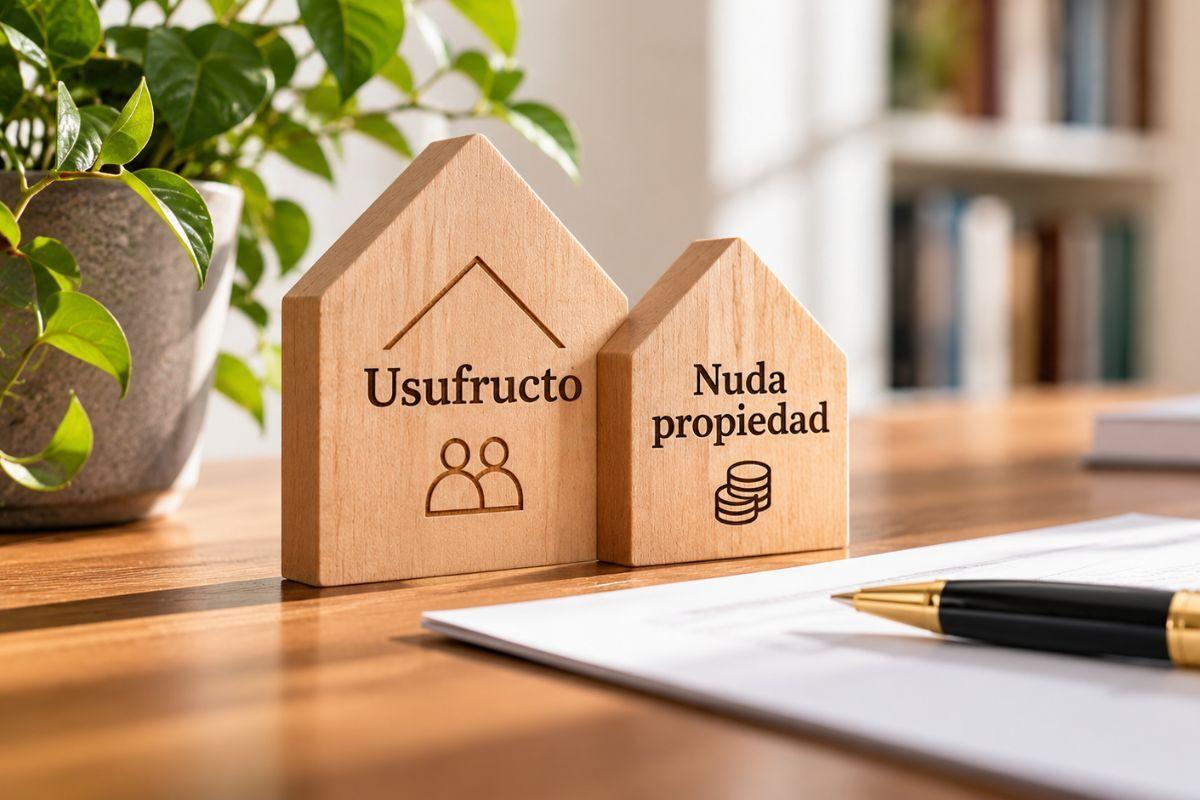
Selling bare ownership or a home with a usufruct in Catalunya: who signs, how the price is split and which taxes each party pays.
If the inherited home is in Vilanova i la Geltrú or the Garraf, we can sell it for you: how we sell in Vilanova. And if you'd like to know what it's worth first, ask for a free valuation.
It's a very common situation after a death: the widow or widower keeps the usufruct of the house (usufructo, the right to use it) and the children keep the bare ownership (nuda propiedad). As long as nobody wants to sell, it all works. But the day comes when the house is too big, the money is needed or the children would rather share things out, and the questions start: who has to sign? How is the price split? Which taxes does each person pay?
Here's how a home with split ownership is sold in Catalunya, with the law behind each point.
The essentials
Two rights over the same house. The usufructuary uses it or collects the rent; the bare owner owns it, but can't use it until the usufruct ends.
To sell the whole house, everyone signs. The usufructuary sells the usufruct and each bare owner sells their share of the bare ownership, in the same public deed (escritura).
You can also sell just one part. The bare ownership or the usufruct can be sold separately, although buyers are harder to find.
The price split is negotiated. The table based on the usufructuary's age is a tax rule, not a civil-law obligation.
Each person pays their own taxes. Income tax (IRPF) and municipal capital gains tax (plusvalía municipal) are dealt with separately, and the exemption for over-65s doesn't apply to a usufructuary who sells together with the bare owners.
Why does a home end up split into usufruct and bare ownership?
In Catalunya, it usually happens through an inheritance. If someone dies without a will, leaving a spouse or stable partner (parella estable) and children, the children inherit and the surviving spouse has the universal usufruct (usufructo universal) over the whole estate, with no guarantee required (Civil Code of Catalunya, Book Four, art. 442-3). That usufruct isn't lost even if the surviving spouse remarries or lives with someone else (art. 442-4).
The surviving spouse can swap that universal usufruct for a quarter of the estate plus the usufruct of the family home, and has one year from the death to decide (art. 442-5). That's why, even so, it's common for the usufruct of the house to stay with the surviving spouse.
It's also common with a will: the deceased can leave a bequest of universal usufruct to their spouse and even give them powers to sell (art. 427-34). It also happens when parents gift the bare ownership and keep the usufruct for themselves.
If the inheritance hasn't been accepted yet, that's the first step. We explain it in our article on selling an inherited flat in Catalunya.
What can each party do with the home?
Book Five of the Civil Code of Catalunya governs usufruct from art. 561-1 onwards. In short:
The usufructuary can live in the house or let it out and keep the rent. In return, they pay for upkeep, ordinary repairs, utilities and annual taxes such as property tax (IBI). If they're an individual, the usufruct lasts for life unless the title that created it says otherwise (art. 561-3).
The bare owner is the owner, but without the use of it. They cover extraordinary repairs and, when the usufruct ends, they recover full ownership (pleno dominio) without having to do anything else.
Each party can dispose of their own right: the usufruct ‘may be disposed of under any title’ and the bare owner can sell the bare ownership, always without harming the usufructuary (art. 561-9).
Who has to sign to sell the whole house?
For the buyer to receive full ownership, everyone has to sell at the same time: the usufructuary sells the usufruct and the bare owners sell the bare ownership. It's usually done in a single public deed before a notary, with one price that is then shared out.
If the bare owners are several siblings, selling the whole bare ownership requires unanimity (art. 552-7). Each of them can sell their own share, but very few buyers are interested in part of a bare ownership.
There is one exception: a usufruct with power of disposal (usufructo con facultad de disponer). If the will or the title provides for it, the usufructuary can sell the home on their own (arts. 561-21 to 561-24). If the power applies only ‘in case of need’, they must notify the bare owners within one month, and any part of the price not spent on that need remains subject to the usufruct (arts. 561-23 and 561-24). Before anything else, it's worth reading the will carefully.
Can you sell just the bare ownership or just the usufruct?
Yes, both are possible (art. 561-9).
Selling the bare ownership. The usufructuary carries on living in the house and the buyer will receive it in full when the usufruct ends. It tends to appeal to investors who can wait, and the price is lower than for the same home without a usufruct, because the buyer doesn't know when they'll be able to use it.
Selling the usufruct. This is much less common. If the usufructuary sells it to a third party, the bare owners have priority to take it themselves: one month from being formally notified or, if they weren't notified, three months to exercise their right of redemption (retracto) and take over the sale (art. 561-10).
A joint sale usually gets the best price, because the buyer can move in straight away.
How is the price split between the usufructuary and the bare owners?
This is a very common misunderstanding. Many people think there's a compulsory table. There isn't: under civil law, the split is agreed between the parties.
The table everyone quotes is a tax rule. It's used to calculate taxes such as inheritance tax (impuesto de sucesiones) or property transfer tax (transmisiones patrimoniales), under art. 26 of the Inheritance and Gift Tax Act:
Life usufruct: 70% of the value if the usufructuary is under 20, one point less for each additional year of age, with a minimum of 10%. The Catalan Tax Agency (Agència Tributària de Catalunya) sums it up as ‘89 minus age’.
Fixed-term usufruct: 2% for each year it lasts, up to a maximum of 70%.
Bare ownership: the rest, up to 100%.
For example, with a 79-year-old usufructuary, the table gives the usufruct 10% and the bare ownership 90%. You can use it as a reference point for negotiating, but the family can agree something else: that the surviving spouse receives more, that they get the usufruct over the money, or that they set part of it aside to buy another home. What matters is putting it in writing in the deed, because how the price is split affects each person's taxes.
Which taxes does each party pay when selling?
Each holder sells their own right, so each one declares their own part.
Income tax (IRPF). Each person is taxed on the difference between what they receive and what their right cost them. If they inherited it, the acquisition value is the one declared for inheritance tax. The manual published by the Spanish Tax Agency (Agencia Tributaria) explains that the value of a life usufruct goes down over the years, which usually increases the usufructuary's gain. You'll find the general calculation in our article on income tax when selling a home.
Watch out for the over-65 exemption. Selling your main home when you're over 65 is exempt from income tax (Income Tax Act, art. 33.4.b). But according to the Spanish Tax Agency's position, backed by a 2018 Supreme Court ruling, when ownership is split it applies neither to the usufructuary nor to the bare owner, even if the usufructuary lives in the house. It does apply to someone who held full ownership and sells the bare ownership while keeping a life usufruct.
Municipal capital gains tax. It applies both to selling the property and to selling the usufruct, and the seller pays it (Local Government Finance Act, arts. 104 and 106). For the usufruct, the taxable base is worked out with the same valuation rules as for transfer tax (art. 107). We cover it in our article on municipal capital gains tax.
What if you wait for the usufruct to end?
When the usufructuary dies, the usufruct ends and the bare owner gets full ownership. There's no income tax to pay on that consolidation of ownership, or consolidación del dominio (Spanish Tax Agency, end of a usufruct).
However, if the usufruct arose from an inheritance or a gift, the bare owner has to file inheritance tax on the part they now consolidate (Inheritance and Gift Tax Act, art. 26.c). The Catalan Tax Agency explains consolidation of ownership and which form applies depending on how the usufruct was created.
Whether it's better to wait or to sell depends on the usufructuary's age and whether they need the money. The sensible thing is to have the gestoría (administrative and tax adviser) or the notary's office run the numbers on both options.
What should you prepare before putting the house on the market?
Know exactly who owns what. The land registry extract (nota simple) from the Land Registry shows the usufruct, the bare ownership and each bare owner's percentage.
Read the title. The will or the deed of inheritance says whether the usufruct is for life or fixed-term and whether there's a power of disposal.
Agree the split before looking for a buyer. Better to settle it calmly than with an offer on the table.
Start from a realistic market price. If the money has to be shared, everyone gains if the house sells well and within a reasonable time.
If the co-owners would rather one of them kept the home instead of selling it, there's another route: we explain it in our article on dissolving joint ownership.
If you have a home with a usufruct in Vilanova i la Geltrú or the Garraf and are thinking about selling it, we can value it and explain how to make the sale work for everyone involved.
Keep reading

Thinking of selling?
We call you, come and see it, and tell you what it's worth and how we'd sell it.